
How to Make a Career in Medical Coding and Billing — Complete Guide 2026
If you have a B.Pharm, D.Pharm, B.Sc, or any life sciences degree and want a stable healthcare career without becoming a doctor, medical coding and billing is one of the smartest paths available right now. You can work from home, earn a decent salary, grow fast, and even work for international clients sitting in India. This guide explains everything from scratch — what medical coding actually is, who can do it, how to get certified, what you will earn, and exactly how to start.
Sudhanshu Bhariya
5/26/20268 min read
What Is Medical Coding — Explained Simply
Every time a patient visits a doctor, gets a diagnosis, undergoes a procedure, or receives a prescription, that information needs to be recorded in a standardized format. Hospitals use these records for billing insurance companies, maintaining patient histories, and reporting health data to government bodies.
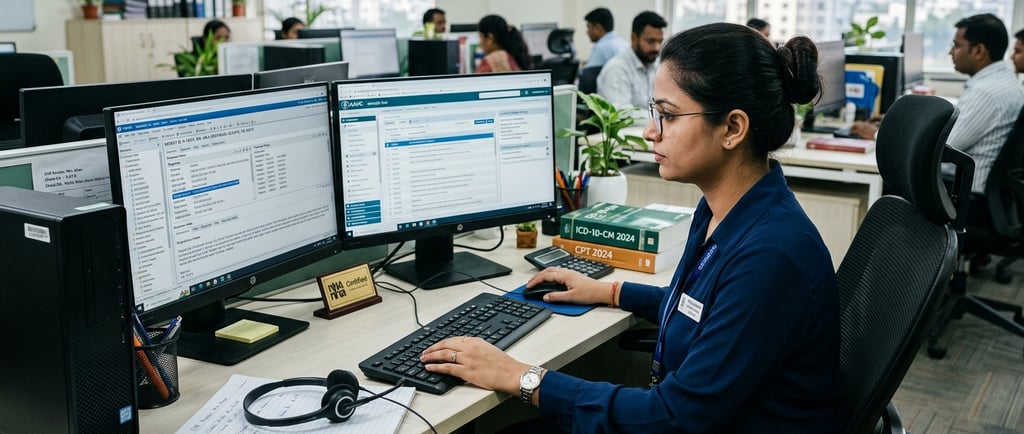
Medical coding is the process of converting all of that clinical information — doctor notes, diagnoses, procedures, lab reports, and treatment details — into universal alphanumeric codes.
A medical coder reads patient records, doctor notes, diagnosis details, procedures, lab reports, and insurance documents and then converts them into standard healthcare codes.
These codes come from three main coding systems. ICD-10-CM covers diagnoses and diseases — for example, Type 2 diabetes has a specific code, and so does a broken left wrist. CPT codes cover procedures and services — every surgery, injection, consultation, and test has its own CPT code. HCPCS Level II codes cover medical supplies, equipment, and services not covered under CPT — things like ambulance transport, prosthetics, and certain drugs.
Medical billing takes this one step further. A medical biller takes the codes produced by the coder and uses them to create insurance claims, submit them to payers, follow up on rejections, and ensure the hospital or clinic gets paid correctly.
In simple terms — the coder translates the medical record into codes, and the biller uses those codes to get the money.
Why Medical Coding Is a Smart Career in 2026
In 2026, medical coding is considered one of the most stable non-clinical healthcare careers, especially for people who want to work in healthcare without directly treating patients.
Three things are driving demand right now. First, India has become a major hub for healthcare outsourcing. US and UK hospitals and insurance companies outsource their coding and billing work to India because of cost advantages and a large English-speaking workforce. Second, India's own health insurance industry — including Ayushman Bharat — is expanding rapidly, creating domestic demand for trained coders. Third, most coding work can be done entirely from home, making it one of the few healthcare careers that offers genuine remote work.
According to the 2026 Medical Coding and Billing Salary Report by AAPC, 64.8 percent of medical records specialists work fully remote, highlighting the real shift toward flexible work in this field.
Who Can Become a Medical Coder — Eligibility
This is the part that surprises most people.
Medical coding eligibility does not require NEET, entrance exams, or clinical experience.
The minimum qualification is 10+2 with a science background. However, candidates with the following degrees have a significant advantage and get hired faster and at higher salaries — B.Pharm, D.Pharm, B.Sc in Life Sciences, Biotechnology or Microbiology, MBBS, BDS, BAMS, nursing, and physiotherapy.
If you are a pharmacy graduate reading this, your anatomy and pharmacology background gives you a genuine edge over non-science candidates. You already understand medical terminology, drug names, and disease classifications — which are the hardest parts for non-science candidates to learn.
There is no age limit. Freshers and career switchers both enter this field regularly.
The Three Coding Systems You Must Know
Before you start preparing, understand what you are actually learning.
ICD-10-CM stands for International Classification of Diseases, 10th Revision, Clinical Modification. This system classifies diseases, symptoms, signs, injuries, and causes of death. It has over 70,000 codes. Every diagnosis a doctor writes gets converted into an ICD-10-CM code by the coder.
CPT stands for Current Procedural Terminology. Published by the American Medical Association, CPT codes cover every medical procedure and service — from a simple office visit to a complex open-heart surgery. There are over 10,000 CPT codes. These are the codes most commonly tested in the CPC certification exam.
HCPCS Level II covers items and services not found in CPT — medical equipment, ambulance services, certain injectable drugs, prosthetics, and orthotics. These are especially important for billing Medicare and Medicaid claims in the US market.
As an Indian coder working for US clients, you will use all three systems daily.
Certifications — Which One Should You Get
Getting certified is not just a formality — it directly determines how much you earn and which companies hire you.
CPC — Certified Professional Coder
The CPC certification offered by AAPC — American Academy of Professional Coders — is the gold standard in the industry globally and in India. Over 250,000 professionals hold this credential globally, with numbers growing in India due to healthcare BPOs.
The CPC exam has 100 multiple choice questions covering anatomy, medical terminology, ICD-10-CM, CPT, HCPCS, and coding guidelines. You get 5 hours and 40 minutes to complete it. A passing score is 70 percent.
CPC Exam Cost in India
AAPC Membership costs approximately Rs. 16,500 to Rs. 19,500 per year. The CPC Exam Fee for members is approximately Rs. 33,000 and for non-members approximately Rs. 41,000. Study materials cost Rs. 15,000 to Rs. 25,000. Training programs range from Rs. 30,000 to Rs. 1,50,000 depending on the institute.
This investment pays off with starting pay of Rs. 4 to 6 lakh per year for certified coders.
CCS — Certified Coding Specialist
The CCS certification is offered by AHIMA — American Health Information Management Association. It is more focused on hospital inpatient coding and is well recognized in the US market. If you want to work with hospital records rather than physician billing, CCS is worth considering alongside CPC.
COC — Certified Outpatient Coder
Also offered by AAPC, the COC certification is for coders who work specifically in outpatient and ambulatory care settings. Many experienced coders add this after their CPC to specialize further.
Which Should You Start With
Start with CPC. It is the most recognized certification in India for US healthcare outsourcing roles, it opens the most entry-level doors, and most Indian CROs and BPOs specifically ask for CPC certified candidates.
Salary — Real Numbers for 2026
Medical coding salary in India has grown 35 percent in the last 3 years.
For fresh graduates entering the field, medical coding salary for freshers typically ranges from Rs. 15,000 to Rs. 25,000 per month. Fresh CPC-certified coders start at Rs. 20,000 to Rs. 28,000 versus Rs. 15,000 to Rs. 20,000 for non-certified coders.
An early career medical coder with 1 to 4 years of experience earns an average total compensation of Rs. 3,08,234 per year.
Experienced coders can earn Rs. 6 to 10 lakh per year depending on specialization and the type of company.
Salary by Experience Level
Fresher with no certification — Rs. 15,000 to Rs. 20,000 per month. Fresher with CPC certification — Rs. 20,000 to Rs. 28,000 per month. 1 to 3 years experience — Rs. 25,000 to Rs. 40,000 per month. 3 to 5 years experience — Rs. 40,000 to Rs. 60,000 per month. Senior coder or team lead with 5 plus years — Rs. 60,000 to Rs. 1,00,000 per month.
Coders who work directly for US clients or international BPOs earn significantly more than those working for domestic companies at the same experience level.
Job Roles in Medical Coding and Billing
Medical Coding Specialist is the most common entry level role. You review patient charts and assign ICD-10, CPT, and HCPCS codes. Most coding BPOs hire at this level.
Medical Biller creates and submits insurance claims using the codes provided by the coder, follows up on claim rejections, and handles account receivables.
Medical Coding Auditor reviews the work of other coders for accuracy and compliance. This is a mid to senior level role that pays significantly higher.
Coding Team Leader or Supervisor manages a team of coders, handles quality checks, client communication, and productivity metrics.
Health Information Manager oversees the entire health information and coding department at a hospital or large healthcare organization.
Different industries including Government Health Programs, Health Insurance Companies, Healthcare IT, and Software Companies offer positions like Certified Professional Coder, Medical Billing and Coding Specialist, Health Information Technician, and Medical Coding Consultant.
Where Do Medical Coders Work in India
Healthcare BPOs and KPOs are the largest employers — companies like Omega Healthcare, Startek, Access Healthcare, Allscripts, and EXL Healthcare specifically hire large numbers of coders for US healthcare clients.
Hospitals and diagnostic chains hire medical coders for their internal billing and insurance claim teams, especially large chains like Apollo, Fortis, and Manipal.
Health insurance companies including Star Health, Niva Bupa, and government schemes like Ayushman Bharat need coders for claim processing.
Healthcare IT companies that build hospital management software and electronic health record systems hire coders as subject matter experts.
Remote freelance work for US physician practices and billing companies is also growing — experienced certified coders can earn in dollars working independently from home.
Skills You Need to Succeed
Medical terminology is the foundation. You need to understand anatomy, disease names, surgical terms, and drug names — which is why pharmacy graduates have an advantage.
Attention to detail matters more in this job than almost any other. A single wrong digit in a code can result in a claim rejection or a compliance violation.
ICD-10-CM, CPT, and HCPCS knowledge is the core technical skill — this is what certifications test and what employers expect.
Understanding of anatomy and physiology helps you accurately assign codes for procedures — knowing which body system is involved and what exactly was done during a surgery.
Computer skills including working with electronic health record systems, coding software, and billing platforms are required at most employers.
Step by Step — How to Start Your Medical Coding Career
Step 1 — Complete Your Basics First
If you are a pharmacy or life sciences graduate, you already have medical terminology and anatomy covered. If you are from a non-science background, spend 2 to 3 months on basic anatomy, physiology, and medical terminology before touching the coding systems.
Step 2 — Learn ICD-10-CM, CPT, and HCPCS
You can learn these through the AAPC online self-paced course, coaching institutes in your city, or YouTube channels dedicated to medical coding. Focus on understanding the structure and logic of each system — not just memorizing codes.
Step 3 — Get CPC Certified
Register for AAPC membership first, then register for the CPC exam. Give yourself 4 to 6 months of focused preparation. Practice coding real patient records — not just theory. AAPC provides practice exams and study materials on its website.
Step 4 — Build Practical Experience
Some employers hire freshers without experience if they are CPC certified. If you are struggling to get your first job, look for internships at hospitals, shadow experienced coders, or take up small freelance projects to build your portfolio.
Step 5 — Apply to BPOs and Healthcare Companies
Use Naukri, LinkedIn, and Indeed to search for medical coding jobs. Filter for CPC certified roles. Large BPOs like Omega Healthcare, Access Healthcare, and Startek regularly hire fresh certified coders in cities like Hyderabad, Chennai, Bangalore, and Pune.
Is Medical Coding Right for You — Honest Assessment
Medical coding suits you if you are detail-oriented and careful with numbers and codes, comfortable working with computer systems for long hours, interested in healthcare but do not want a clinical patient-facing role, and looking for work from home opportunities.
Medical coding may not suit you if you get bored doing repetitive work, struggle with anatomy and medical terminology, or prefer a dynamic field with frequent travel or patient interaction.
Future of Medical Coding — Should You Worry About AI
This is a fair question. AI tools are being developed to assist with medical coding. However, as automation handles routine tasks, hybrid roles combining coding with data analysis and IT skills are emerging. The coders who specialize in complex cases, auditing, and compliance will remain in high demand regardless of AI advances. Getting certified and building deep expertise in a specific specialty — oncology coding, cardiology coding, or orthopedic coding — protects your career from automation.
Final Thoughts
Medical coding and billing is one of the most practical and underrated career paths for pharmacy and life sciences graduates in India right now. The entry barrier is low, the certification is achievable with 4 to 6 months of focused preparation, the work can be done from home, and the salary grows steadily with experience and specialization.
If you are a B.Pharm or D.Pharm graduate who has not considered medical coding yet, it deserves a serious look — especially if you want a stable, growing healthcare career without the uncertainty of pharma field jobs.
Follow The Pharma Insider on YouTube and Instagram for more career guidance every week.