5 Entry Level Jobs in Clinical Research for Pharma Freshers — Real Salary Data 2026 April 19, 2026 | Clinical Research | The Pharma Insider
Most pharmacy graduates think Clinical Research is only for experienced professionals. That is completely wrong. The CRO industry in India is growing faster than almost any other sector in pharma, and companies like IQVIA, Parexel, Syneos Health, and PPD are actively hiring freshers right now. You just need to know which roles are actually open to you. This guide breaks down 5 real entry level jobs in Clinical Research that a B.Pharm, D.Pharm, M.Pharm, or Life Sciences graduate can apply for without prior experience. Real job titles, real salary data, and exactly what each role involves.
sudhanshu
4/18/20268 min read

Why Clinical Research Is One of the Best Career Moves for Pharma Freshers in 2026
India has become one of the most important hubs for global clinical trials. With a massive patient pool, cost advantages, and skilled science graduates, multinational CROs have been expanding their India operations every year. This growth means consistent hiring at the entry level, international exposure from day one, and a salary trajectory that beats most traditional pharma jobs within 3 to 4 years.
Freshers entering Clinical Research can expect Rs. 20,000 to Rs. 30,000 per month in entry level roles, with fast growth and global exposure in CRA jobs. More importantly, unlike MR jobs or hospital pharmacy, Clinical Research gives you a career path that can eventually take you international.
Job 1 — Clinical Trial Assistant (CTA)
This is the most beginner-friendly entry point into the CRO world. A Clinical Trial Assistant supports the clinical operations team by handling administrative and documentation tasks for ongoing clinical trials. You are not running the trial yourself — you are making sure the paperwork, files, and logistics are organized so the clinical team can do their job.
What you actually do as a CTA: You maintain the Trial Master File (TMF), which is the official document collection for a clinical trial. You coordinate with investigator sites for document collection and follow-ups. You manage correspondence between the CRO and the sponsor. You track regulatory submission timelines and help with meeting preparations. You use electronic data capture systems for filing and tracking.
Why it is perfect for freshers: No prior clinical experience is required. The role is primarily documentation and coordination, which any organized pharmacy graduate can handle. It gives you direct exposure to how real clinical trials work — phases, protocols, regulatory submissions — which becomes the foundation for moving into a CRA role later.
The salary for a Clinical Trial Assistant typically ranges between Rs. 3.5 LPA and Rs. 6.5 LPA, and freshers and early career candidates can apply.
The average salary for a Clinical Trial Assistant in India is around Rs. 3,26,726 per year.
Companies currently hiring CTAs: Syneos Health, IQVIA, Parexel, Labcorp, PPD, Fortrea.
Skills you need: MS Office proficiency, basic understanding of GCP guidelines, attention to detail, and good written English communication.
Growth path: CTA to Clinical Research Associate (CRA) typically takes 1 to 2 years.
Job 2 — Clinical Research Coordinator (CRC)
A Clinical Research Coordinator works at the investigator site — meaning inside a hospital, clinic, or research center — rather than at a CRO. This is one of the most accessible entry points because hospital-based research centers hire frequently and the role is very hands-on.
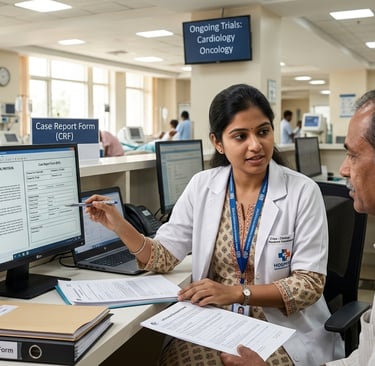
What you actually do as a CRC: You screen and enroll patients into clinical trials. You explain the study to patients and manage informed consent. You collect clinical data, biological samples, and patient assessments during study visits. You maintain source documents and case report forms. You coordinate with the sponsor company or CRO for monitoring visits. You report adverse events and ensure the trial follows the protocol.
Why this role is valuable for freshers: You get direct patient and clinical trial exposure from day one. Hospitals like AIIMS, Tata Memorial, Apollo, Max Healthcare, and Manipal actively hire fresh pharmacy and life sciences graduates as CRCs. This role gives you real site experience, which is extremely valuable when you later apply for CRA or senior clinical roles.
Salary range: Rs. 2.5 LPA to Rs. 4.5 LPA at hospital-based sites. CRO-sponsored CRC positions at companies like Labcorp can go up to Rs. 6.5 LPA.
Companies and hospitals currently hiring: Labcorp, Max Healthcare, Tata Memorial Centre, AIIMS research divisions, Apollo Hospitals research department.
Skills you need: Basic GCP knowledge, patient communication skills, understanding of clinical trial phases, data collection accuracy, and ability to handle regulatory documentation.
Growth path: CRC to Senior CRC or directly to Trainee CRA roles within 2 years.
Job 3 — Clinical Data Coordinator or Clinical Data Associate (CDA)
If you prefer working with data over patient interaction or field monitoring, this is your entry point. A Clinical Data Coordinator is the junior level of Clinical Data Management — the team responsible for collecting, cleaning, and validating data from clinical trials before it goes to the statisticians for analysis.
What you actually do as a CDA: You enter and verify clinical trial data in Electronic Data Capture systems like Medidata Rave, Oracle Inform, or Veeva Vault. You identify data discrepancies and raise queries to investigator sites for clarification. You follow data cleaning plans and validation rules set by senior CDMs. You help with database setup, testing, and lock activities. You generate and track data queries until they are resolved.
Why this role suits freshers: It requires technical attention to detail more than clinical experience. If you are comfortable with computers, spreadsheets, and structured data, you can train into this role quickly. Many CROs run structured training programs for fresh CDAs before putting them on live projects.
At IQVIA, Clinical Data Associate and Clinical Healthcare Operations entry roles for freshers typically range from Rs. 3.5 LPA to Rs. 6.0 LPA total CTC.
Companies currently hiring CDAs: IQVIA, Syneos Health, Parexel, Cognizant Life Sciences, Wipro BPS Healthcare, Accenture Life Sciences.
Skills you need: Basic Excel, familiarity with any EDC tool is a plus but not mandatory, logical thinking for data validation, and accuracy in documentation.
Growth path: CDA to Clinical Data Manager (CDM) typically takes 2 to 3 years. CDM salaries in India range from Rs. 6 LPA to Rs. 14 LPA with experience.
Job 4 — Patient Safety Associate / Drug Safety Associate (Pharmacovigilance)
Pharmacovigilance is one of the fastest growing areas in Clinical Research right now and it is genuinely fresher-friendly. A Patient Safety Associate or Drug Safety Associate is responsible for processing Individual Case Safety Reports (ICSRs) — which are reports of adverse drug reactions received from patients, healthcare professionals, and clinical trials around the world.
What you actually do as a PSA or DSA: You review incoming adverse event reports from global sources. You enter case data into safety databases like Argus Safety or ARISg. You use MedDRA dictionary to code adverse events with standardized medical terms. You assess case seriousness, causality, and expectedness based on guidelines. You ensure cases are reported to regulatory authorities within defined timelines. You process literature cases by screening biomedical journals for safety signals.
Why this role is perfect for freshers: Companies like Parexel, IQVIA, Syneos, and ICON specifically hire freshers for this role and train them internally. The work is structured, systematic, and purely desk based — no travel, no field visits. It also has very strong demand because every drug on the market requires ongoing safety monitoring by law.
At IQVIA, entry level Drug Safety Associate roles pay Rs. 4 LPA to Rs. 6 LPA. At Parexel, entry level is Rs. 4 LPA to Rs. 6 LPA with senior level going up to Rs. 16 LPA. Syneos Health pays Rs. 3.5 LPA to Rs. 12 LPA depending on experience.
Companies currently hiring freshers: Parexel Mohali, IQVIA Bangalore and Chennai, Syneos Health, ICON, Accenture Life Sciences, Clarivate Noida.
Skills you need: Basic pharmacology and drug knowledge from your B.Pharm curriculum, attention to detail, good English reading and writing, and willingness to learn MedDRA coding and safety database tools.
Growth path: Patient Safety Associate to Senior DSA to Drug Safety Scientist typically within 3 to 4 years, with significant salary jumps at each level.
Job 5 — Regulatory Affairs Associate (Entry Level)
Regulatory Affairs is a slightly different track from traditional clinical operations, but it sits within the Clinical Research ecosystem and is one of the highest paying long-term careers in pharma. A Regulatory Affairs Associate helps prepare and manage the documents required to get drugs approved by regulatory authorities like CDSCO in India, the US FDA, or the European EMA.
What you actually do as a Regulatory Affairs Associate: You compile regulatory submission dossiers including CTD format documents. You track regulatory timelines and maintain submission status trackers. You research regulatory requirements for different countries and therapeutic areas. You review labeling, product inserts, and package information for compliance. You communicate with regulatory agencies for queries and clarifications. You maintain the regulatory information management database.
Why freshers can get in: Entry level regulatory roles are specifically designed for fresh B.Pharm or M.Pharm graduates who have studied pharmaceutical law, drug regulations, and quality standards. Your academic knowledge is directly applicable here.
Salary range: Rs. 3 LPA to Rs. 6 LPA at the entry level. Senior Regulatory Affairs professionals with 5 to 7 years experience earn Rs. 15 LPA to Rs. 30 LPA, making this one of the highest ceiling careers in pharma.
Companies currently hiring: Sun Pharma, Dr. Reddy's Laboratories, Cipla, Lupin, Parexel Regulatory, ICON Regulatory, Freyr Solutions, Veeva Systems, and most large CROs.
Skills you need: Knowledge of CTD format, ICH guidelines, Drugs and Cosmetics Act, CDSCO submission process, strong documentation writing, and attention to regulatory detail.
Growth path: Regulatory Affairs Associate to Senior RA Specialist to RA Manager to Head of Regulatory — each step comes with significant salary and responsibility increase.
How to Actually Get Into These Roles as a Fresher — Honest Advice
The biggest mistake freshers make is applying to senior roles and getting discouraged. These 5 roles above are your actual entry points. Here is what actually works.
First, get your GCP certification. ICH GCP E6 R2 is the foundation of all clinical research. Free versions are available from the NIH website and TransCelerate. Having this certification on your resume immediately signals to recruiters that you are serious about the field.
Second, learn the basics of one EDC tool. Medidata Rave has free training resources. REDCap is completely free and widely used in academic research. Even basic familiarity with these tools puts you ahead of candidates who have no exposure.
Third, tailor your resume for each role. Do not send the same generic pharmacy resume for a CTA role and a Drug Safety role. Each role has different keywords and requirements. Match your resume to the job description every time.
Fourth, target CROs directly before pharma companies. IQVIA, Parexel, Syneos Health, PPD, and ICON hire more freshers than pharma companies because they work on multiple trials simultaneously. Their India offices in Bangalore, Hyderabad, Mumbai, Pune, Chennai, and Mohali are consistently hiring.
Fifth, LinkedIn is your most powerful tool in this field. Clinical Research hiring managers actively look at profiles. Follow CRO companies, engage with their posts, and connect with people already working in these roles. A direct message to a recruiter has converted into jobs for many people in this field.
Salary Summary — All 5 Roles at a Glance
Clinical Trial Assistant pays Rs. 3.5 LPA to Rs. 6.5 LPA at the fresher level with growth to CRA roles within 1 to 2 years.
Clinical Research Coordinator pays Rs. 2.5 LPA to Rs. 6.5 LPA depending on whether it is a hospital or CRO-based position, with direct path to CRA roles.
Clinical Data Associate pays Rs. 3.5 LPA to Rs. 6 LPA at IQVIA and similar CROs, with CDM roles paying Rs. 8 LPA to Rs. 14 LPA after 2 to 3 years.
Patient Safety Associate pays Rs. 3.5 LPA to Rs. 6 LPA at entry level with fast growth trajectory reaching Rs. 12 LPA to Rs. 16 LPA at senior levels.
Regulatory Affairs Associate pays Rs. 3 LPA to Rs. 6 LPA at entry with one of the highest long-term ceilings in pharma at Rs. 25 LPA to Rs. 35 LPA for senior professionals.
Final Thoughts
Clinical Research is not a backup career. It is one of the most structured, globally respected, and financially rewarding tracks available to pharmacy graduates in 2026. The five roles covered in this guide — Clinical Trial Assistant, Clinical Research Coordinator, Clinical Data Associate, Patient Safety Associate, and Regulatory Affairs Associate — are all genuinely accessible to freshers with a B.Pharm, D.Pharm, M.Pharm, or Life Sciences degree.
Start with GCP certification, pick the role that matches your strengths, and target CROs directly. The opportunities are there — you just need to know where to look and how to position yourself correctly.
Follow The Pharma Insider on YouTube and Instagram for weekly career guidance on Clinical Research, Pharmacovigilance, and Regulatory Affairs jobs in India.